
How to Brush a Short-Haired Cat Without a Struggle
Learn how to brush a short-haired cat gently, choose a suitable brush or mitt, and decide when to stop. Includes frequency guidance and grooming-tool differences.
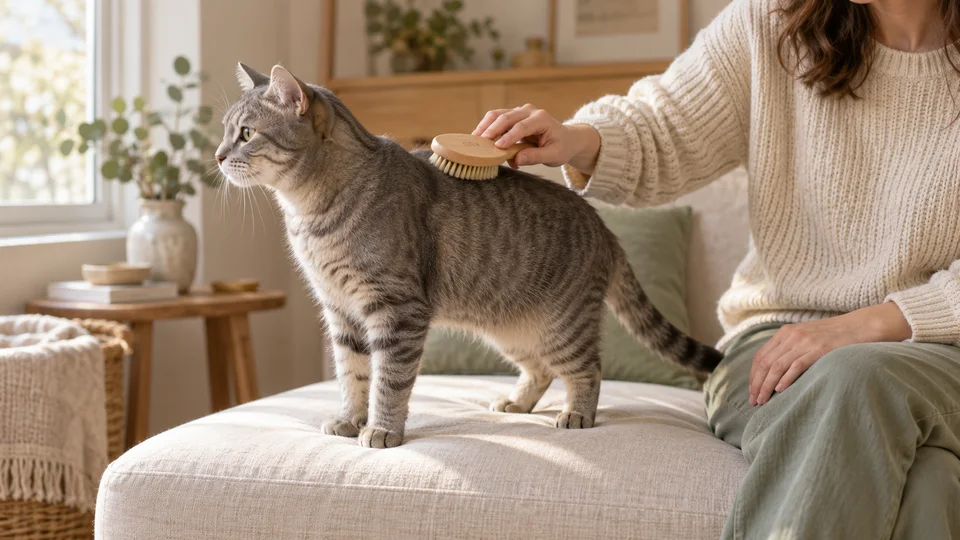
To brush a short-haired cat, start with a suitable soft brush or grooming mitt, a relaxed cat and a few gentle strokes in the direction of the fur. Let the cat leave. You do not have to finish the whole coat in one sitting, and collecting a large pile of hair is not the goal.
A brush can look small and harmless to us and still feel unfamiliar to a cat. The useful first session may be nothing more than leaving the tool nearby, letting the cat investigate and putting it away again.
Choose a tool your cat can comfortably accept
Cats Protection suggests that a short-haired cat may prefer a soft brush or grooming mitt; a mitt can feel more like ordinary stroking. Start with the coat type and the cat’s response rather than the most dramatic before-and-after picture on the package.
A pin brush, a soft-bristle brush and an undercoat tool are different products. Check the working surface and the maker’s directions. Do not use the recommended schedule for one tool as the instructions for another. FURminator explicitly distinguishes undercoat removal from ordinary brushing and limits its undercoat tool to suitable coats.
If you are comparing the CatMellow Mini Bamboo Pin Cat Brush, read its current product details and inspect the pin design. Its name describes a pin brush; it is not evidence that it performs like a metal undercoat-removal tool. Ask for guidance if you are unsure what suits your cat.
Source: Cats Protection: Grooming Your Cat
Look at the Mini Bamboo Pin Cat Brush and its current details
Keep the first attempt easy to leave
Choose a familiar place where your cat already spends time. Have the brush ready before inviting them over, with no need to hold them on a slippery surface. If your cat walks away when the tool appears, that is enough for today.
Cats Protection recommends introducing grooming in small amounts with as little restraint as possible. A short, uneventful encounter gives you something to build on. If previous grooming has been frightening or essential care cannot be managed, ask your vet about suitable professional help.
Use light strokes and pause before doing more
On an area your cat normally accepts being touched, make a small number of light strokes following the hair’s direction. FURminator’s general brushing guide also emphasizes brushing with the coat and avoiding heavy pressure. Stay away from any area that looks sore or feels tangled.
Pause and put the brush down. Does your cat remain nearby and move normally, or turn toward the brush and try to leave? Let that answer guide the next step. You can stop after one small area. There is no requirement to work from nose to tail before the session counts.
Do not chase the last loose hair by repeatedly brushing the same patch. The amount collected depends on the coat and tool. A brush that collects only a little hair has not necessarily failed, and pressing harder is not a useful performance test.
Source: FURminator: Brushing Your Pet
How often does a short-haired cat need brushing?
Cats Protection gives weekly brushing as a possible starting point for short-haired cats, with some needing more attention during shedding periods. VCA likewise notes that short coats may need less frequent brushing than long coats. These are starting points, not a timetable every cat must meet.
Keep a simple note of the tool used, how your cat responded and anything unusual you noticed. That is more useful than timing every session. If the coat suddenly changes or your cat stops managing normal grooming, discuss the change with your veterinarian instead of just increasing brush time.
Source: VCA Animal Hospitals: Grooming and Coat Care for Your Cat
Know what belongs outside a routine brushing session
A tight mat is not a reason to pull harder. VCA warns against using scissors to remove mats and recommends professional help for severe tangles or skin irritation. Stop around a painful patch, unexplained hair loss or a change that concerns you.
Keep clothing out of the way while checking the coat. If your cat sometimes wears an outfit, remove it before grooming so you can see the skin and fur. Clothing is optional and should not be used to hide shedding or a coat problem.
Put the brush away ready for next time
Remove the collected hair and clean the tool according to its own care instructions. Let it dry as directed before storage. Keep the working surface where it will not be bent or pressed beneath other objects, and check it before each use.
A useful home routine is easy to repeat: one suitable tool, a familiar place and permission to stop. If your cat prefers a mitt to the brush you bought, change the tool. The aim is a manageable grooming habit, not persuading the cat to accept a particular purchase.
Frequently asked questions
- Do short-haired cats need the same brush as long-haired cats?
- Not necessarily. Match the tool to the coat and your cat’s tolerance. A soft brush or mitt may suit a short-haired cat; ask your veterinary team if you are unsure.
- Should I brush against the fur to collect more hair?
- Use gentle strokes in the direction of the fur and follow the tool’s instructions. More collected hair is not a reason to increase pressure or repeatedly work one patch.
- Is a daily undercoat-removal session necessary?
- No universal schedule applies. Undercoat tools differ from everyday brushes and must be suitable for the coat. Follow the specific tool’s directions and get advice if needed.