
Cat Brush vs Grooming Mitt: Which Should You Try First?
Choosing a cat brush or grooming mitt? Compare the working surface, coat type, handling and cleaning before buying, with a clear distinction between everyday tools.
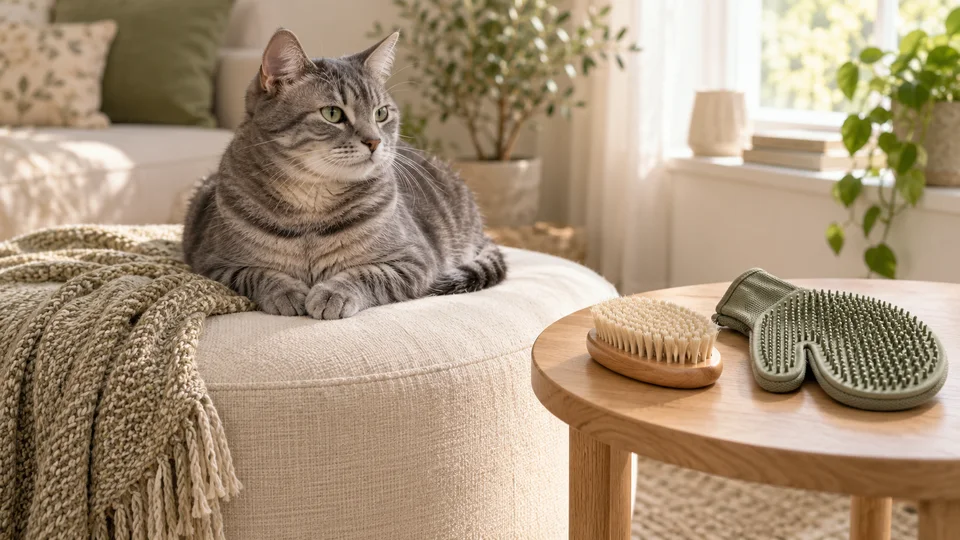
A grooming mitt may be worth trying for a short-haired cat who accepts gentle stroking, while a suitable brush offers a different grip and working surface. Neither is best for every cat. Compare the actual bristles, pins or nubs, the coat they are intended for, and how comfortably your cat accepts the tool.
Two listings can promise the same tidy sofa while selling very different things. One is a hand-shaped mitt with rubber nubs; the other is a handled brush with pins. Start with that difference, before comparing photographs of the hair each one supposedly collects.
“Brush” is a category, not a single tool
Look closely at the head. Soft bristles, rounded pins, fine metal wires and undercoat-removal edges are different working surfaces. A wooden handle tells you little about what touches the coat. Read the description and inspect the close-up photograph together.
The same care applies to mitts and gloves. Some have a broad textured palm; others have separate fingers, a fabric reverse side or a wrist fastening. Check the actual shape, dimensions and cleaning instructions. The word gentle on a package does not establish how a tool will feel to an individual cat.
Cats Protection notes that some short-haired cats prefer a soft brush or grooming mitt, and that a mitt can resemble stroking. That offers a starting option, not a promise that a cat who dislikes grooming will welcome a gloved hand.
Compare what you can inspect before buying
You do not need to buy both tools to begin comparing them. Read the product details with these questions in front of you. If the working surface is hidden in the photos, ask to see it.
| Detail | What to compare |
|---|---|
| Contact surface | For a brush, identify the bristles or pins. For a mitt, inspect the nubs and any fabric panel. |
| Your grip | Check the handle size or mitt fit so the tool stays controlled without squeezing. |
| Intended coat | Read the maker’s coat-type guidance; do not assume every grooming tool suits every cat. |
| Cleaning | Look for instructions for removing hair, washing and drying the exact materials. |
| Replacement | Find out what damaged bristles, pins, seams or nubs would make the tool unsuitable to keep using. |
Choose for the cat in front of you
Think about ordinary handling first. Where does your cat accept being touched? Do they move away when a new object approaches? Does wearing a glove change the way you reach toward them? These observations are more useful than assuming a mitt will be invisible to the cat.
Keep the first introduction separate from a full grooming session. Let the cat investigate without blocking their route away. If they remain comfortable, a brief trial on an area they normally accept being touched gives you information. Stop when they move away or show discomfort; do not chase a comparison result.
For the actual brushing routine, use our separate short-haired cat guide. This buying comparison does not replace the instructions for the tool you choose.
Do not rank tools by the largest pile of fur
A photograph of collected hair leaves out the coat, the time spent and the pressure used. It cannot tell you whether a tool will be comfortable for your cat. Avoid making several passes over one area simply to see which tool produces more.
Decide what a useful result means before the trial: the tool is appropriate for the coat, you can use it as directed, and the cat remains comfortable. A short session that ends calmly is useful even if there is very little hair to remove from the tool.
A mat or sore area changes the task. Do not try to pull through it with a mitt or repeatedly work it with a brush. VCA recommends professional help for severe tangles and warns against using scissors to remove mats. Ask your veterinary team if you are unsure how to handle a coat problem.
Source: VCA Animal Hospitals: Grooming and Coat Care for Your Cat
Where the CatMellow bamboo-pin brush fits in
The current CatMellow Mini Cat Brush listing describes a compact manual brush with a dark wood handle, rounded bamboo pins and a vented TPR cushion. It is a pin brush. It is not the soft-bristle brush or rubber mitt shown in this article’s illustrative cover.
Use the close-up product photographs to compare that pin design with what you are looking for. The listed materials do not establish that it is the right choice for every coat, nor do they make it an undercoat-removal tool. If your veterinary team has recommended a particular brush type, match that advice to the working surface before buying.
There is no need to buy a second tool merely to complete a set. Start with one suitable option and keep it if it works comfortably in your routine. A mitt may remain the better choice for a particular cat even when you prefer the look of a wooden brush.
Think about the next cleanup as well
A tool that is awkward to clean may be awkward to keep using. Before purchase, find the care instructions rather than assuming that wood, rubber, fabric and cushioned parts can all be washed the same way. Follow the instructions for drying as well as cleaning.
After use, check the contact surface and store the tool where it will not be crushed. Replace or stop using it if parts are damaged according to the maker’s guidance. If you cannot find suitable care information, ask the seller; an attractive photograph is not a substitute for knowing how to maintain the item.
Frequently asked questions
- Can a grooming glove replace every cat brush?
- No. Mitts, pin brushes, soft brushes and specialist tools have different designs. Match the working surface to the coat and the cat’s tolerance rather than treating them as interchangeable.
- Is a grooming mitt a good option for a short-haired cat?
- It may be. Cats Protection lists mitts among options for short-haired cats, but preference varies. Introduce the tool gently and stop if the cat is uncomfortable.
- Should I use both a mitt and a brush in one session?
- There is no need to use both simply because you own them. Follow the appropriate tool’s directions and let your cat’s comfort determine when to stop.