
Autumn Dog Walks After Dark: A Simple Before-the-Door Checklist
Prepare for darker autumn dog walks with a practical check of clothing, reflective gear, leash attachment and route before leaving home.
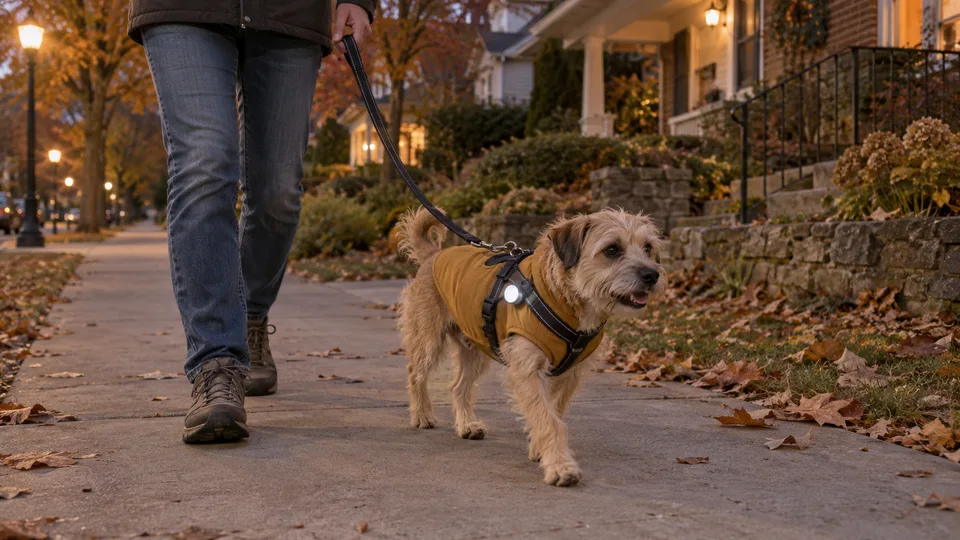
The evening walk can start in daylight and finish under streetlights. Before heading out, check what the route will be like on the way home: rain, cooler air, traffic and how easily other people can see you and your dog.
Treat warmth, rain coverage and visibility as separate questions. A comfortable sweater does not establish that a dog is visible after dark, and a reflective accessory does not tell you whether a coat is suitable for wet weather.
Choose the route before choosing the outfit
Favor a familiar route with lighting and room to pass other walkers. Think about driveways, road crossings and stretches where you would struggle to see the surface. A shorter, clearer route can be a better evening choice than adding another piece of equipment.
The RSPCA's winter guidance recommends well-lit places and reflective or LED gear for dogs and people. Its walking guidance also emphasizes keeping your dog within sight. Local rules vary, so check the requirements where you walk.
Source: RSPCA: winter care for dogs
Match the clothing to the weather on this walk
Check the forecast and what is happening outside your door. If you are deciding whether your dog needs a layer at all, use our coat guide first. For rain, look at the product's stated coverage and weather protection rather than choosing by how padded it looks.
A knit sweater should not be assumed to work as a rain shell. Equally, a light rain layer does not establish that a dog has enough warmth for colder conditions. Choose for the conditions and your dog, then keep an eye on how they respond.
Related guides: Does my dog need a coat? and Choosing a dog raincoat.
Check the visibility features you actually have
Look for an explicit description of reflective details or a suitable light. Do not assume a bright garment color means the fabric is reflective. If the product page does not specify that feature, plan visibility separately.
Place a light or reflective accessory according to its instructions and check that fur, a hood or another layer does not cover it. Turn lights on before leaving and check the charge. Clothing and accessories can help with being seen, but they do not make a crossing or an unlit route automatically safe.
Remember the person holding the leash
Check your own visibility too. A reflective detail hidden underneath a dark jacket does little for the outfit you are actually wearing. Carry a light that lets you see the path and pick up after your dog without struggling with the leash.
Keep bags and other small essentials where you can reach them. A simple setup you can manage comfortably is more useful than several accessories competing for the same hand.
Check the leash attachment with every layer on
Fit the clothing and walking equipment together before leaving. Check the harness straps, buckle and leash clip, then let your dog move. A new layer can change where a strap sits or hide the attachment point.
Do not clip a leash to a decorative garment ring unless its intended use is confirmed. If you are unsure how a coat and harness should work together, our harness guide walks through the checks to make.
Pause at the door for one last look
Look at the whole arrangement while your dog stands naturally. Sleeves should stay clear of paws; the hem should leave bathroom access; the leash clip should be easy to identify. Turn on the light, check that the accessory is secure and pick a route you can shorten if needed.
During the walk, check again if the coat shifts or the dog repeatedly stops to fuss with it. Head home if the setup is not working. You can make the next walk simpler after you have seen what needs changing.
- Check the weather and return route.
- Check normal movement with clothing and harness on.
- Check that lights work and visibility features are uncovered.
- Check the leash connection, then carry bags and a path light.
Make the next walk easier when you get home
Remove damp clothing, inspect the contact areas and follow the garment's care instructions. Keep walking lights with the leash so you can check their charge before the next outing.
If you are browsing CatMellow for a new layer, compare the size chart, underside cut and leash access on the individual listing. Ask about any feature that is unclear. The illustration for this article shows a general walking setup; it is not evidence that a particular CatMellow garment is reflective or waterproof.
Frequently asked questions
- Is a bright-colored dog coat enough for a night walk?
- Check the product's stated visibility features. Bright color alone does not confirm reflectivity. Consider suitable reflective or LED equipment for both you and your dog, alongside a well-lit route.
- Does every dog need a coat after dark?
- Darkness is not the deciding factor for warmth. Consider the weather and your individual dog. Visibility and secure walking equipment still need their own checks.
- Can I attach a walking light to a sweater?
- Follow the light's attachment instructions and use a secure, suitable location. Avoid an arrangement that pulls on loose knit, dangles within reach or becomes covered by fabric.
- Should a raincoat replace a harness?
- Only use a garment attachment for restraint if that purpose is confirmed by the manufacturer. Otherwise use suitable walking equipment and check how it fits with the coat.