
Dog Halloween Costumes: A Comfortable Outfit Starts Small
Choose a dog Halloween costume with room to move, simple details, and an easy exit plan. Try three low-fuss outfit ideas for a short photo at home.
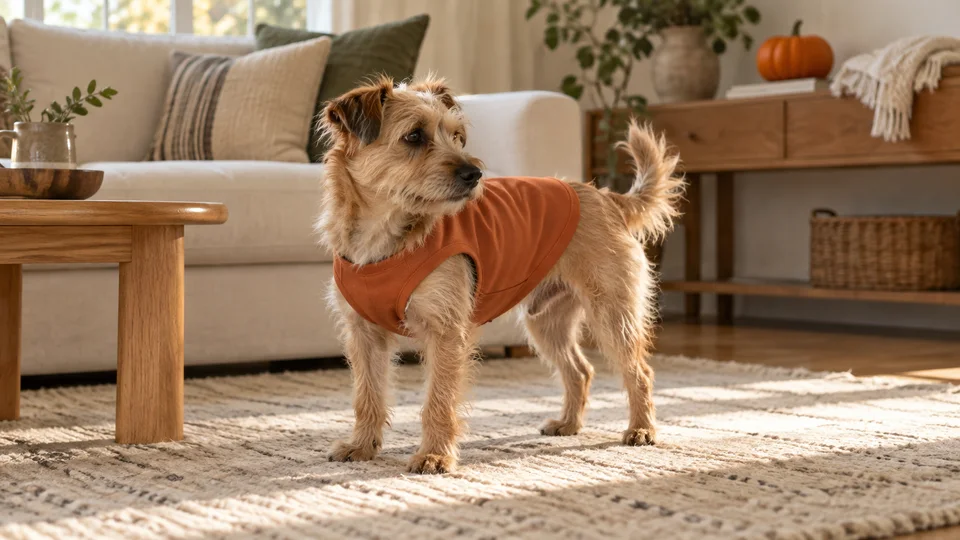
Choose a dog Halloween costume your dog can walk, sit, and turn in without the outfit shifting across the face or legs. Start with something simple, try it at home, and take it off if your dog seems uncomfortable. A festive photo does not need a headpiece, wings, or a full-body suit.
The outfit that looks charming on a product page may be awkward at your front door. Before choosing a character, decide what the evening actually involves: one photo in the living room, visitors arriving, or a walk past unfamiliar decorations. Those are three different plans.
Pick the occasion before the costume
For a photo at home, you control the light, background, and timing. A familiar plain vest in an autumn color may be enough. Put the seasonal detail in the room rather than adding more pieces to your dog. Keep decorations out of reach and leave a clear route away from the camera.
An evening with repeated doorbell rings asks something different of your dog. Decide where they can settle before choosing an outfit. If you will spend the evening answering the door, you may have little time to supervise clothing. Take the picture earlier and put the outfit away.
An outdoor Halloween event adds crowds, noise, and unfamiliar shapes. Chewy's veterinarian-reviewed outing guide recommends considering the individual dog's comfort with the situation and having a way to leave. An outfit that works in your hallway is not evidence that your dog will enjoy trick-or-treating.
Three simple looks without a complicated costume
An orange vest and a neutral room make a restrained pumpkin-season picture. Use a garment your dog already accepts, if you have one. The orange does the visual work; a pumpkin hat adds another fit problem without making the photograph much clearer.
For a woodland feel, pair a muted green sweater with a cream blanket in the background. Keep the blanket on the furniture, not draped over your dog. A little space around the subject often makes a better picture than a crowded arrangement of props.
For a matching family photo, repeat one color in your own clothing. Your dog can wear a familiar plain garment or no clothing at all. Matching does not have to mean identical costumes. Choose the version that lets everyone settle quickly.
Inspect the outfit off the dog first
Lay it flat and examine the inside as carefully as the front. Where are the seams, closures, and attached decorations? Work out how you will remove it before the first fitting. If removal requires pulling several tight sections over the head and feet, consider a simpler cut.
Chewy's Halloween safety guidance advises checking for loose decorations, making sure clothing does not restrict breathing or movement, and supervising a costumed pet. Treat these as minimum requirements. They do not establish that every dog will enjoy wearing an otherwise well-made outfit.
Photographs taken from above can hide the belly opening and leg holes. Look for side and underside views when shopping. If those details are missing, request them instead of choosing only by the costume's character or a breed pictured on the page.
Source: Chewy: veterinarian-reviewed Halloween pet safety tips
Make the first fitting an ordinary moment
Choose a quiet time rather than putting the costume on as guests arrive. Let your dog investigate it, then follow the garment's dressing instructions without forcing limbs through a difficult opening. Keep the first try brief enough that it is easy to stop.
Watch an ordinary walk across the room, a turn, and a sit. Check whether a panel rotates, a hem catches, or an attachment knocks against a leg. A still photograph can conceal all three. There is no reason to keep testing an outfit that your dog is trying to escape.
| What you notice | What to do next |
|---|---|
| The garment twists when your dog turns | Recheck the cut and size. Do not solve rotation by overtightening it. |
| The body fits, but an attached piece hits a leg | Choose a simpler design rather than expecting the dog to ignore it. |
| Your dog moves normally and appears settled | Keep the photo session brief and continue supervising. |
| Your dog hides, freezes, or repeatedly tries to remove it | Take it off. Use a seasonal background without clothing. |
Finish the photo before the outfit becomes a project
Set up the room and camera first. A plain wall, window light, and a familiar floor are enough. Photograph from your dog's level and leave space around the paws and ears. You can improve a busy background without asking the dog to wear anything extra.
Keep a clear finish point: take a few pictures, remove the outfit, and continue the day. Do not leave a costume on while you sort photographs or answer messages. If the picture only works after repeated adjustments and repositioning, simplify the idea.
When browsing dog clothing, start with measurements and the actual garment construction. In CatMellow's dog clothing collection, compare everyday styles by their cut and measurements, then choose a color that works with your photo setting.
Frequently asked questions
- Can my dog wear a Halloween costume all evening?
- Plan for a brief, supervised fitting or photo instead of assuming an all-evening outfit will be comfortable. Remove it when the photo is over or sooner if your dog seems unhappy.
- What is a simple Halloween outfit for a dog?
- A familiar plain orange or green garment can suggest the season without extra attachments. A festive background with no clothing is also a complete photo idea.
- Should I buy a larger costume to make it comfortable?
- Not automatically. Extra fabric can shift or catch. Compare the actual measurements and observe the garment during movement; a different cut may work better than a larger size.