
How Should a Dog Sweater Fit? A Calm At-Home Try-On Guide
Check your dog's sweater at the neck, chest, leg openings and hem, then watch them move. A practical guide to spotting a fit that needs changing.
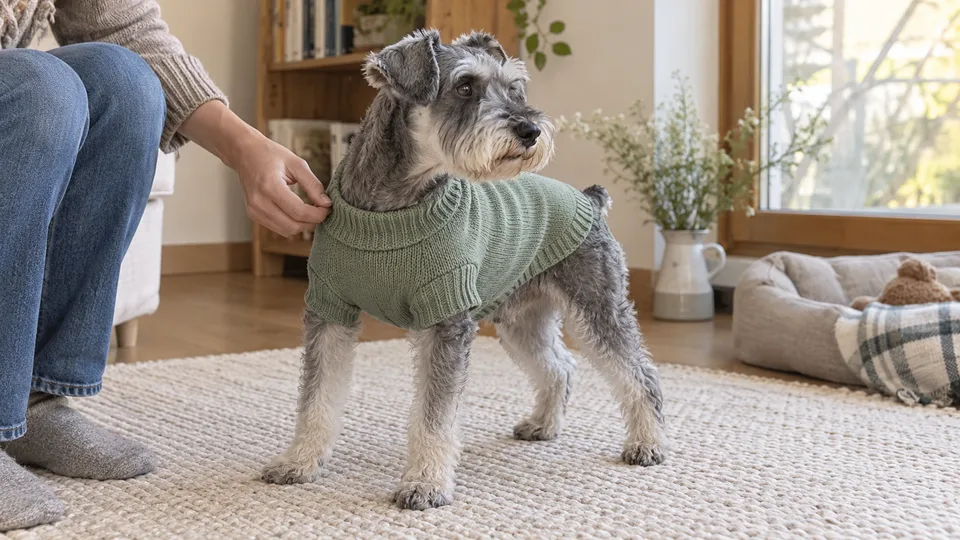
A dog sweater can match the size chart and still feel wrong when your dog walks. The useful test happens after it goes on: can your dog turn, sit and move their front legs normally, with the fabric staying clear of their paws and bathroom breaks?
Choose a quiet moment at home for the first try-on. Keep it brief, leave room for your dog to move away, and watch the dog before looking at the outfit. A neat photograph is less useful than an easy, ordinary walk across the room.
Start with the chart for this sweater
Use the measurements requested on the individual product page, rather than carrying a size label from another garment. For most sweaters, that means chest, back and neck. Record the units clearly and check whether the chart describes your dog's body or the finished sweater.
Our dog clothing measurement guide covers taking those numbers. This guide starts with the next step: checking the garment you have in your hands. Before dressing your dog, look for twisted seams, damaged stitching or loose threads that might catch a claw.
Look at the neckline and shoulders
The neckline should settle comfortably without folding against the throat or dragging the sweater forward. Watch the shoulder area as your dog lowers their head and turns toward you. If the knit pulls across the front, check the position of the garment and its size.
Put the sweater on according to its design. If you have to force a leg through an opening or pull hard over the head, stop and reconsider the garment. Stretch is useful for dressing, but it should not be the reason a too-small sweater appears to fit.
Check the chest and front-leg openings
Smooth the sweater into its natural position, then inspect the chest and the openings behind the front legs. Fabric should not gather into a thick fold in the armpit. A seam that sits quietly while the dog stands may still rub when they take a step.
A quick finger check can reveal obvious tightness, but it cannot replace watching movement. Avoid treating a fixed finger allowance as a guarantee: a narrow ribbed edge, a thick seam and a stretchy body panel behave differently. Let your dog walk before deciding that an opening is comfortable.
Check the hem from the side and underneath
Look at where the sweater ends around the tail and lower belly. The hem should stay clear when your dog sits and uses the bathroom. Check your particular dog's body and the garment's underside cut; the back length alone does not answer this question.
Too much spare fabric can be a problem as well. If the sweater slips sideways, hangs near the paws or catches beneath a leg, a larger size has not solved the fit. Photograph the side and underside if you need help explaining what is happening.
Let your dog do something ordinary
Invite a short walk across a familiar room. Let your dog turn, sit and lie down if they choose. Watch whether the sweater twists, the sleeves slide or the back panel rides forward. You do not need a performance or a long practice session.
If your dog freezes, repeatedly bites the knit or moves differently, remove the sweater and pause. Those responses do not tell you on their own whether the issue is size, texture or wearing clothing at all. A different size is not automatically the answer.
If the fit is off, describe the problem before changing sizes
A tight chest with a long back is a different problem from a loose neckline and slipping sleeves. Write down which area fails and compare it with the chart. If your dog's measurements fall across different sizes, ask for guidance rather than automatically sizing up.
When contacting CatMellow, include the product name, the size you tried and the measurements with units. A clear description such as 'the chest pulls when she sits, but the hem already reaches the tail' is more useful than 'medium feels wrong.'
Recheck after washing or changing walking gear
Before the next outing, check that the sweater has kept its shape and that the openings sit where they did during the first try-on. Follow its care label rather than assuming every knit can be washed the same way.
If you add a harness or outer layer, repeat the movement check with that combination. Extra fabric can shift the pressure points. Our washing and harness guides help with those next decisions.
Related guides: How to wash dog clothes and Harness over or under a coat?.
Frequently asked questions
- Should a dog sweater be tight or loose?
- It should stay in place while allowing normal movement. Check the neckline, chest, front-leg openings and hem; neither pulling fabric nor slipping sleeves is a useful fit.
- Should I always size up if my dog is between sizes?
- Check the individual chart and which measurement falls between sizes. A larger sweater may leave the neck or sleeves too loose. Ask about the specific garment if chest and back measurements point to different sizes.
- Why does my dog stop moving in a sweater?
- Remove it and pause. Fit, texture or discomfort with clothing could be involved. Do not assume your dog needs to get used to it through a longer session.
- Can my dog keep the sweater on all day?
- A successful try-on does not establish that continuous wear is suitable. Use clothing for a specific need, supervise your dog and check comfort regularly. Remove it when that need has passed.