
Dog Clothes Between Sizes? Check These Details Before Sizing Up
Dog between clothing sizes? Compare chest, neck, back length and the exact garment chart, then use a simple checklist before choosing a size or a different cut.
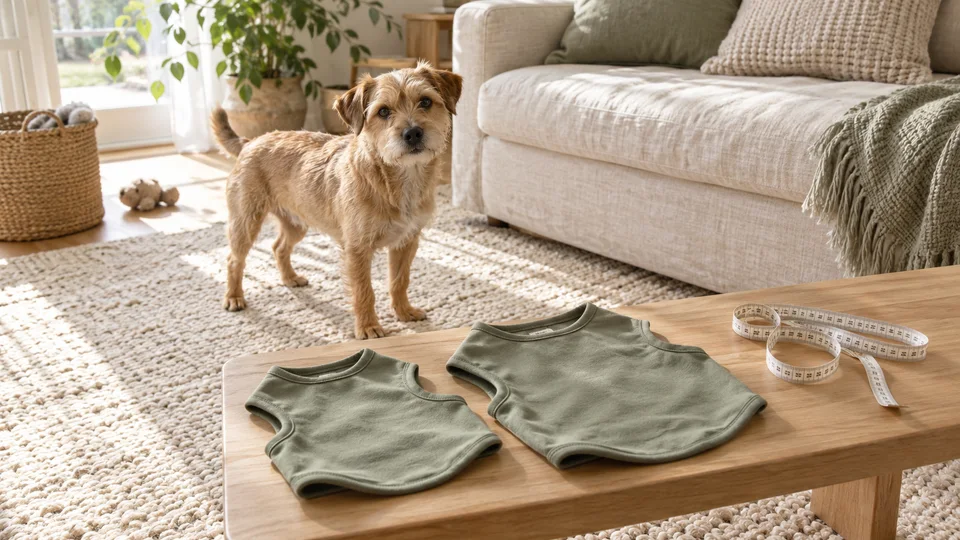
If your dog falls between clothing sizes, do not automatically choose the larger one. Recheck the measurements, read what the exact product chart measures, and compare the neck, chest and back together. If one size is tight and the next is too long or loose, a different cut may be the better choice.
It often starts with one awkward row in a size chart: the chest points to medium, but the back looks closer to small. Buying both is not the only way forward. First, work out whether you have a measurement problem, a chart question or a garment that simply has the wrong proportions.
First, check what the size chart is actually telling you
A chart may show the body measurements a size is intended to fit, or the measurements of the finished garment. Those are different things. A chest circumference measured on your dog cannot be treated as identical to the circumference of a coat lying on the table. Look for an explanation beside the chart; if there is none, ask before ordering.
Keep the units consistent. A number written down without “cm” or “in” is surprisingly easy to misread later. Use the same measurement method on the second attempt, with your dog standing naturally. Do not add a guessed amount of extra room unless the maker’s instructions tell you to.
Save the chart for the exact style and size you are considering. The medium that worked in a stretchy sweater does not settle the size of a woven raincoat. Even within one shop, use each garment’s own information.
Which measurement is causing the mismatch?
Write the three measurements in one row. Underneath, write the relevant entries from each candidate size. This makes the disagreement visible. Do not average the numbers or select whichever size matches two out of three: an opening that is too small does not become acceptable because the back length looks right.
Ruffwear sizes its apparel using chest girth and distinguishes different garment shapes. Canada Pooch’s fit guide also discusses back coverage when a dog falls between sizes. These are useful examples of why sizing advice belongs to a particular design, rather than a universal rule for every coat.
For example, imagine a dog whose chest falls within a larger size, while the listed back length appears too long. This is an illustrative situation, not a CatMellow size recommendation. Ask whether the longer back will affect tail or bathroom clearance, and whether another style offers the needed chest space with a shorter body.
Source: Ruffwear: A Guide to Apparel Fit
A decision sheet for the two sizes
Use these questions to narrow the choice before you buy. If the answer depends on information missing from the listing, keep that question for the seller rather than guessing from a photograph.
| What the chart or try-on shows | What to check next |
|---|---|
| Chest exceeds the smaller size’s stated range | Do not force the smaller size. Check all measurements of the next size. |
| Larger size adds too much back length | Ask about a shorter or differently shaped garment. |
| Neck opening has no adjustment | Ask about the opening and dressing method; do not assume it stretches. |
| Chart gives only a weight range | Request chest, neck and back guidance for this exact style. |
| Measurements sit at a boundary | Confirm how the maker treats the boundary and whether the chart describes body or garment measurements. |
Stretch and adjustment solve different problems
An adjustable strap can change one part of a garment’s fit. It cannot shorten sewn-in sleeves or move a leg opening. Likewise, stretch in the main fabric does not prove that the neck binding, seams and cuffs stretch by the same amount. Check the construction rather than relying on the word flexible.
A bigger size should still sit where the design intends. Watch for a garment rotating around the body, a hanging hem or an opening that shifts toward the front leg. If you need to fold, pin or tie the garment to make it stay in place, ask about another option before using it on a walk.
Send a useful question before placing the order
A clear support message can be short: “I’m considering [product and size]. My dog’s chest is [number and unit], neck is [number and unit], and back is [number and unit], measured using your guide. The chest and back suggest different sizes. Does this chart show body measurements or finished garment measurements? Would you recommend a different cut?”
If you plan to use a harness or another layer, mention that too. Do not increase the size simply to make room without checking the combined fit. Keep any recommendation with the product name so it does not accidentally become the rule for your next purchase.
Let the first try-on answer the remaining question
Read the current return conditions before removing tags or washing a new garment. Try it in a clean, quiet place while you can watch your dog walk, turn, sit and lie down. A still photograph can miss a hem that moves or an opening that catches.
Remove the garment if your dog moves differently, freezes or keeps worrying at it. Do not treat a size-chart match as proof of comfort. Choosing another shape, or leaving clothing off when it is unnecessary, is a valid outcome of the sizing process.
Frequently asked questions
- Should I always size up a dog coat?
- No. Check the specific manufacturer’s guidance and all relevant measurements. A larger size may solve tightness but introduce excess length or shifting.
- Can I choose a dog sweater size from weight alone?
- Use the garment’s measuring instructions. Weight alone does not describe chest shape, neck size or back length, so ask for those details if the listing omits them.
- Can I buy a loose coat for a puppy to grow into?
- Choose for the puppy’s current fit and movement. Future growth does not make excess fabric or slipping openings suitable now. Recheck measurements as the puppy grows.