
Dog Fleece vs. Knit Sweater: What to Compare Before You Buy
Choosing between a dog fleece and a knit sweater? Compare fabric details, openings, coverage and care to find a layer that suits your dog's routine.
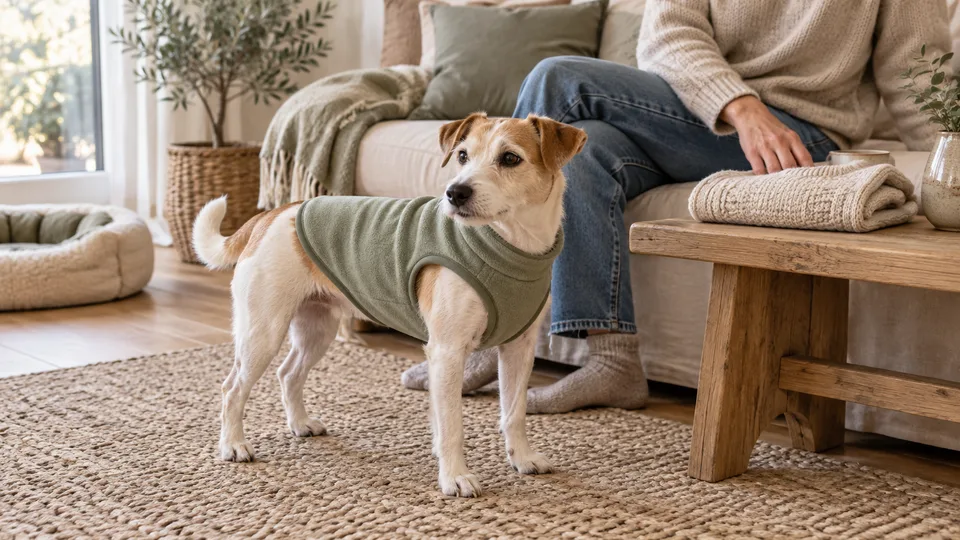
A fleece vest and a cable-knit sweater can look equally inviting on a cool morning. The useful comparison starts with the details you cannot judge from the color: how the garment goes on, where it covers the body and what its care label asks you to do.
Neither name gives you a complete performance rating. Choose between the actual garments in front of you, with a particular outing in mind, rather than assuming every fleece is practical and every knit is decorative.
Read beyond the fabric name
In pet clothing, fleece commonly describes a soft, raised fabric surface, while a knit sweater usually shows a visible stitch pattern. Those shopping labels are not strict opposites: fleece itself can have a knitted base. A garment may also combine a knitted outer surface with a fleecy lining.
Look for the fiber composition, lining details and clear photographs of the inside. A chunky cable pattern does not tell you whether the yarn is wool, cotton, acrylic or a blend. Likewise, the word fleece alone does not tell you the garment's thickness, stretch or weather protection.
When a listing leaves a detail out, ask about it before ordering. It is more useful to know whether the opening stretches or unfastens than to guess from a photograph of a dog standing still.
Compare the opening before the outfit
Put the dressing sequence on your shortlist. Does the garment pull over the head? Must each front paw go through a sleeve? Can it open along the back, chest or side? These questions apply to both fleece and knit styles.
For a dog already comfortable with an open-sided vest, a sweater with narrow sleeves may be a very different experience. Do not assume a softer-looking material will make an unfamiliar dressing method easy. Choose an opening you can handle gently and stop if your dog pulls away or becomes uncomfortable.
Separate texture from coverage
A sleeveless fleece and a long-sleeved knit differ in more than fabric. Compare their belly panels, back length, neck height and leg openings individually. An appealing texture cannot compensate for a hem that shifts into the way.
For example, if your current sweater fits through the chest but its sleeves bunch during a walk, another fabric with the same sleeve shape may repeat the problem. A different cut is worth considering before a different color.
During a brief supervised try-on, let your dog stand, sit, turn and take a few ordinary steps. Check that the garment stays in place without pulling across the shoulders. Use current body measurements and the specific item's size chart.
Choose for the outing you actually take
For a dry neighborhood outing, compare ease of dressing, movement and the care routine you can manage. For rain, start with the garment's stated rain protection. Neither a cozy pile nor a thick knit is proof of waterproof construction.
If you already use a raincoat, check the combined fit before adding either type of layer underneath. Extra fabric changes the available room around the chest and openings. Keep the decision focused on that particular combination rather than buying a larger outer coat by guesswork.
There is no universal outdoor temperature at which one fabric becomes the correct choice for every dog. This comparison is about selecting a garment, not assigning a safe-weather rating to it.
Make the care label part of the comparison
Before choosing, read how each candidate must be washed and dried. Compare those instructions with the space and time you have at home. A garment that needs careful reshaping or flat drying may suit your routine perfectly, but it is worth knowing that before laundry day.
Do not transfer the washing instructions from one fleece or sweater to another. Fasteners, trims and linings can change what is appropriate. If you rotate two garments, give each a chance to become fully dry before it returns to the ready-to-wear drawer.
A short shopping checklist
Save these questions beside the two product listings you are comparing. If one cannot be answered, that is a useful question for the seller.
- What are the listed fibers and lining materials?
- How does it open, and which legs need to pass through sleeves?
- Does its size chart match my dog's current measurements?
- What coverage does the actual cut provide?
- Does the care routine fit the way I wash and dry clothes at home?
Frequently asked questions
- Is fleece always warmer than a knit dog sweater?
- The names alone are not enough to rank warmth. Thickness, construction, lining, coverage and fit differ between individual garments. Look for documented product details rather than assuming one category always wins.
- Is a knitted dog sweater made from wool?
- Not necessarily. Knit describes a fabric construction; check the fiber label to find out whether the garment uses wool, cotton, synthetic fibers or a blend.
- Should I buy both?
- Only if each serves a clear purpose in your routine. Start with the garment that fits comfortably and suits the outing you have in mind. A second piece is useful when it fills a real gap, such as providing a clean change while the first dries.